Italian Greyhound leg fractures: the short answer
An Italian Greyhound does not break from a sneeze, but the bones are slender, and a young dog is at the greatest risk. Puppies are vulnerable because of fine bones, so teach them to jump safely.
The essentials:
- It most often happens in a jump from height (sofa, arms, windowsill), a fall or a bad landing in play.
- Risk is higher in puppies and adolescents, but does not vanish in adults.
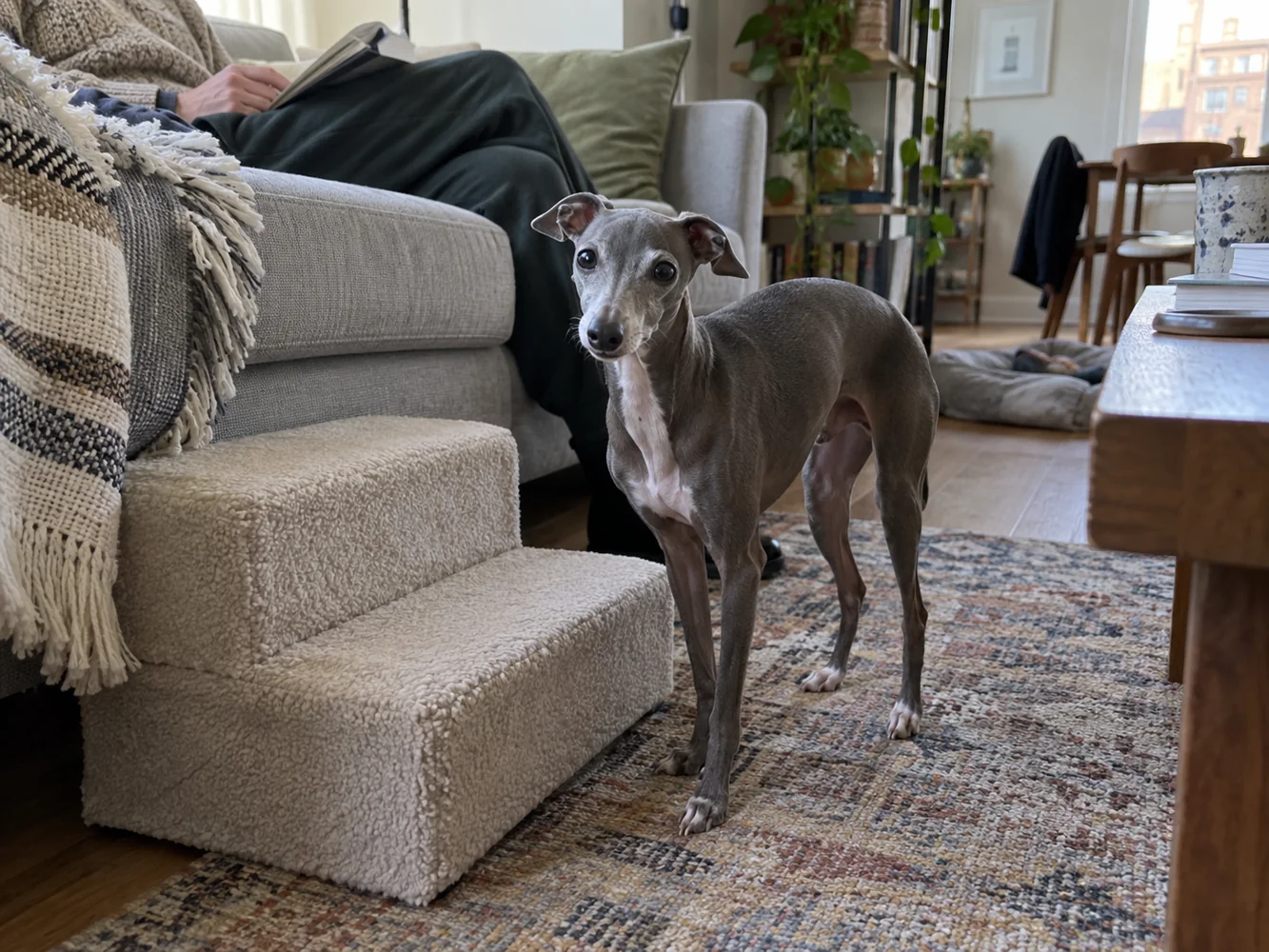
- The most effective protection is to set up the home: a ramp instead of a jump, a non-slip floor and supervision.
- If you suspect a fracture: do not move the leg more than needed, do not give human painkillers and go to the clinic at once.
- In small breeds such fractures are usually treated surgically. The method is chosen by an orthopedic surgeon.
Why Italian Greyhounds have slender bones
An Italian Greyhound is a miniature sighthound with a light skeleton: the standard describes refined bone and thin, lean legs. It is beautiful and convenient for running. But such a leg has less margin of strength than a sturdier dog’s.
The breed club’s 2026 recommendations say Italian Greyhounds are in general sturdier than they look, but young dogs must be looked after: they have an “adventurous spirit” and little caution. Until the dog has gained experience it needs supervision. More in our health article.
How fractures happen
Typical situations:
- a jump off a sofa, chair or windowsill;
- a fall out of arms (it slipped or wriggled free);
- a bad landing in fast play;
- a trapped leg (in a door, between furniture);
- play with a large dog that accidentally falls on it;
- a slippery floor during a sprint;
- stairs, especially going down.
In veterinary orthopedics, forearm fractures, above all of the radius, are well known in miniature and toy breeds and are usually treated surgically. For example, one 2011 study describes 60 distal radial fractures in small-breed dogs treated surgically with external fixation. It is not specifically about Italian Greyhounds, but it shows how such injuries are managed.
How to make the home safe
Sofa and chairs:
- put in a ramp or sturdy steps;
- while the puppy is small, lift it off the sofa;
- never leave a puppy on a height unsupervised.
Floors:
- lay non-slip mats where the dog speeds up: the hall, kitchen, by the sofa;
- keep an eye on nail length: overly long nails can slip on the floor;
- watch for wet puddles.
Stairs and thresholds:
- close the stairs with a puppy gate;
- carry the dog down until it has learned;
- check thresholds and steps in the home.
Windows and balconies:
- secure windows with a proper guard; an insect screen does not protect against falls;
- do not let a puppy onto an open balcony unsupervised.
Doors:
- make sure the dog is not between the door and the frame;
- agree in the family: before closing a door, check where the dog is.
How to hold and carry a puppy
- Hold a puppy low and firmly, supporting the chest and the rear, not by the front legs.
- Do not lift by the armpits or hold at arm’s length above the floor.
- Put it down smoothly; do not toss or shake it.
- Do not let children carry the puppy without adults.
- Do not pull the lead or harness as the dog goes up or down.
Play and walks
- Play with an Italian Greyhound on a soft surface: a carpet or grass.
- Avoid rough play with large dogs: Italian Greyhounds in general do not suit large active dogs.
- Do not throw a ball on a slippery floor or from a height.
- On a walk keep the dog on a lead: a jerk after movement can also hurt a slender leg.
- On ice and in slippery conditions the legs splay: it is better to cut the walk short.
More on safe walks in our article on walks.
Signs of a fracture
- the dog does not put weight on the leg or holds it up;
- it cries out after a jump or fall;
- the leg is swollen, looks bent or hangs “wrongly”;
- the dog will not let you touch the leg;
- it is dull, does not want to move or refuses food.
If you are not sure whether it is a bruise or a fracture, it is better to show the dog to a vet. Do not “test” the leg by making it bear weight.
What to do if you suspect a fracture
- Limit movement: pick the dog up or put it in a carrier.
- Do not try to straighten the leg or splint it yourself.
- Do not give human painkillers (ibuprofen, paracetamol): they are dangerous to dogs.
- Call the clinic and go at once, ideally to an orthopedic surgeon.
- Tell the vet it is a sighthound: sighthounds are sensitive to anesthesia (more in our article on anesthesia).
What the vet does
The vet will examine the dog and, if needed, take an X-ray. The method of treatment is chosen by an orthopedic surgeon: in small breeds such fractures usually need surgery with fixation. Discuss the details of your case with the vet.
Ask before the operation:
- which anesthetic will be used and how the dog will be kept warm (sighthounds are sensitive to anesthesia);
- what the recovery period and routine will be;
- how to care for stitches and bandages at home.
Recovery
The routine after surgery is set by the vet. Do not cancel or shorten it yourself. For an Italian Greyhound this usually means limiting movement until the bone heals and carrying the dog outside. The details depend on the case.
Frequently asked questions
- Is it true Italian Greyhounds break legs more often than other dogs? Young dogs with slender bones really are at risk. But it is not inevitable; it is a risk you can lower.
- Can an Italian Greyhound jump off the sofa? Better not: a jump from height is dangerous, especially for a puppy. Make a ramp.
- What if my Italian Greyhound fell and is limping? Limit movement and show it to a vet.
- Is a cast needed? The vet decides. Do not splint it yourself.
- How much does treatment cost? It depends on the clinic and complexity: ask the vet.
What to remember
- A young Italian Greyhound’s slender bones call for care: a ramp instead of a jump.
- Non-slip floors and supervised play lower the risk.
- If you suspect a fracture, limit movement, give no human painkillers and go to the clinic.
- Before surgery discuss anesthesia: sighthounds are sensitive to it.
Sources
References for checking facts and reading further.
Useful? Save it for your next walk.