
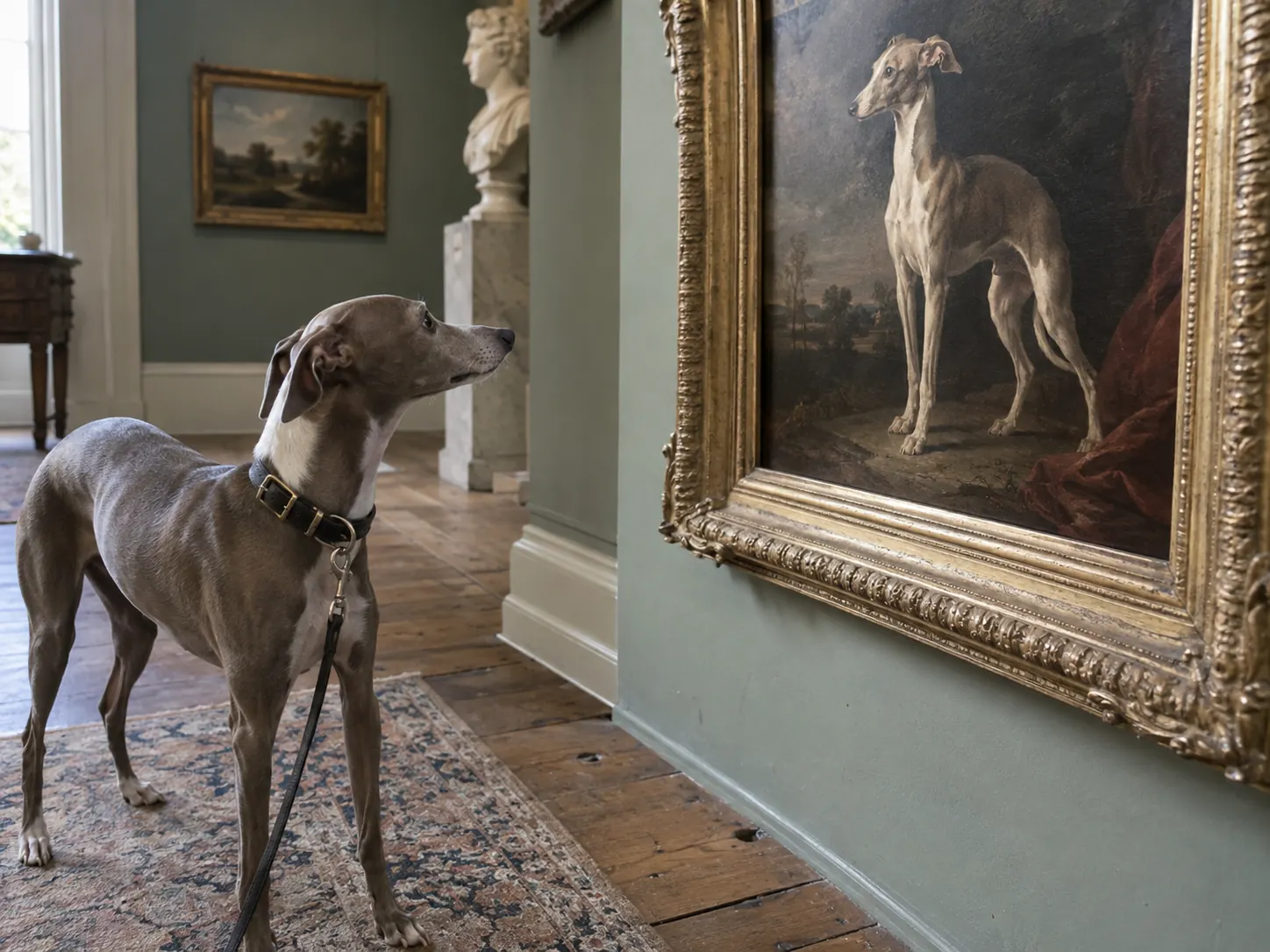
Begin with the artwork
A breed history can too easily label every small sighthound in an old picture as an Italian Greyhound. Artists changed proportions for composition, and several small sighthounds existed. Without provenance, captions and context, a firm identification is difficult.
What an image can reveal
Even without an exact breed name, a painting shows a dog’s place beside a chair, at a person’s feet, on a hunt or in a room. Ask what role the dog has in the scene. That may tell us more about the relationship with small sighthounds than an argument over an ear shape.
Keep modern images honest
The cover of this article is a modern editorial illustration, not archival evidence. We separate historical claims from contemporary imagery. The story is interesting enough without invented proof on a cover.
A small game for your next museum visit
When you spot a slender dog in a painting, start with the museum label: artist, date, title and information about the work. Then look at the animal’s position relative to the people. Does it take part in the action, accompany someone or simply occupy the interior? This can be more rewarding than immediately assigning a modern breed name.
A similar outline does not prove that the artist depicted an Italian Greyhound in today’s breed sense. “Small sighthound” is more cautious unless the museum offers a specific identification. Check social-media stories against the museum’s own catalogue.
At home, continue the game by photographing your dog beside an ordinary chair and comparing composition, lines and posture. It becomes a way to notice how animals share human spaces. The contemporary photo illustration in this article is illustrative, not an archival photograph or a reproduction offered as historical evidence.
Sources
References for checking facts and reading further.
Useful? Save it for your next walk.