Clothing for an Italian Greyhound: the short answer
An Italian Greyhound needs clothing not as decoration but as protection from cold and damp. With a short coat and little body fat it copes poorly with long spells in the cold and is very sensitive to damp, so jackets and boots are recommended. In a warm, dry flat clothing is usually not needed.
The essentials:
- Dress it in cold, damp and wind, especially puppies and seniors.
- Choose by your dog’s measurements, not by weight or breed.
- Clothing must not restrict the stride, press on the neck or belly, or slip down over the legs.
- To start, two or three items are enough: a warm layer, a waterproof outer and, if it is cold, a winter suit or snood.
- At home it is better to take clothing off so the dog does not overheat.
Does an Italian Greyhound need clothing
When it is usually needed:
- you walk in cold, damp or windy weather for more than a few minutes;
- it is wet and cold at the same time (rain, sleet);
- the dog shivers, lifts its paws or pulls toward home;
- it is a puppy, a senior or a weakened dog;
- you are standing still: standing is colder than moving.
When it is usually not needed:
- in a warm flat where the dog rests happily;
- on a very short walk in dry, warm weather.
More on the criteria in our article on whether Italian Greyhounds get cold. The sources we checked give no single temperature, so go by the dog.
What kinds of clothing exist
Our catalogue has several kinds of garment. We describe them by purpose rather than promise properties: fabric compositions are still being confirmed, so see the product cards.
| Kind | What for | What to look at |
|---|---|---|
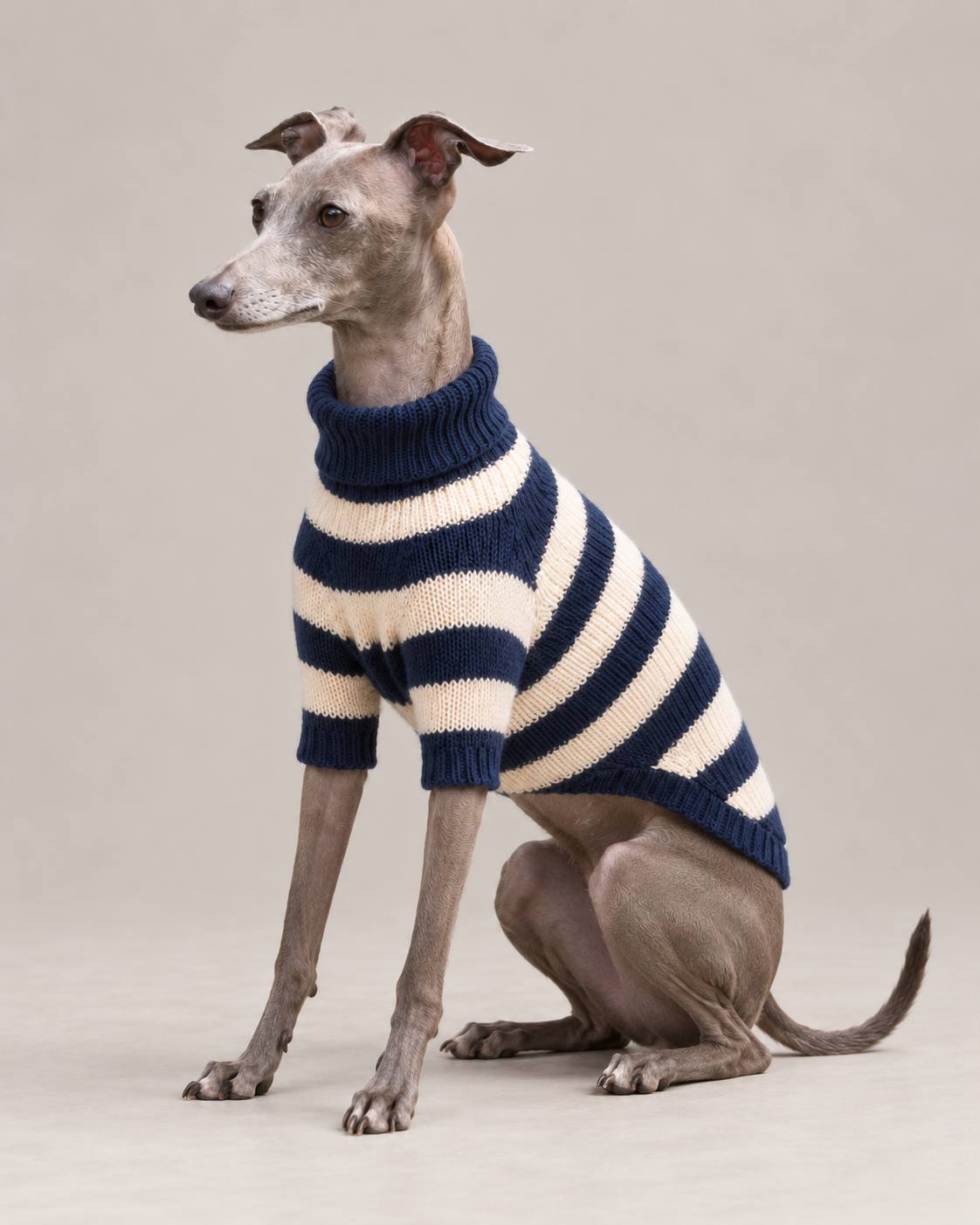
| Sweaters and turtlenecks | a warm layer in cool dry weather, an indoor layer | a high collar, sleeves, freedom under the belly |
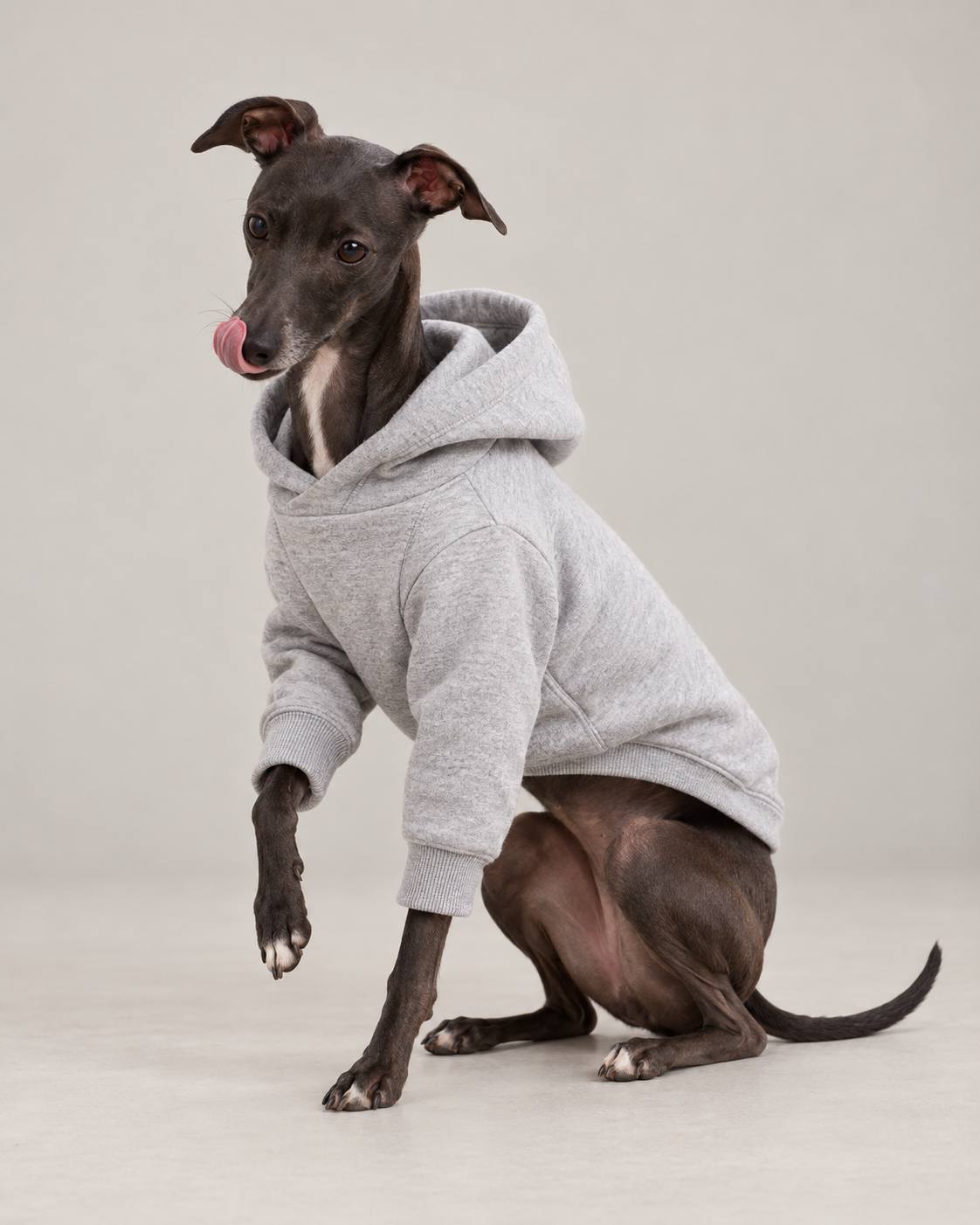
| Hoodies and sweatshirts | a warm layer for walks | whether you need a hood, cuffs, fit at the shoulders |
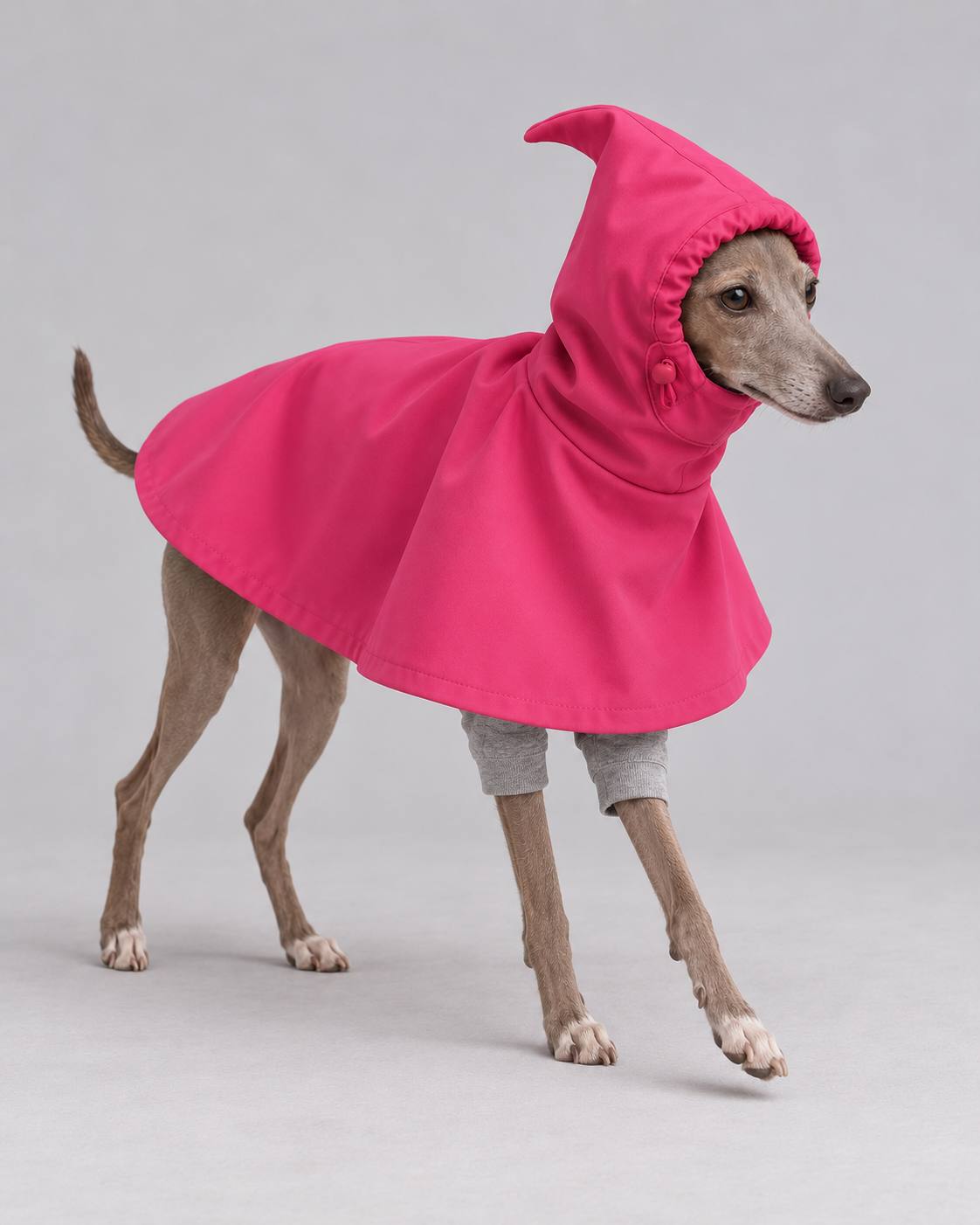
| Ponchos and outerwear | over a warm layer in rain and wind | hood and adjustment, lead attachment, length |
| Winter suits | frost and long walks | sleeves for all four legs, fastening, collar |
| Snoods | protecting the neck and ears | size around the muzzle, density of the knit |
More on each kind in our articles on raincoats, winter suits and how a suit is built.
How to size it
Take three measurements (as on the “Sizes” page of our shop):
- back: from the base of the neck to the base of the tail;
- chest: around the widest part, behind the front legs;
- neck: at the base, without pulling the tape tight.
Compare with the model’s size table. Weight is no use for choosing clothing: two dogs of the same weight can wear different sizes. More in our measuring guide.
How to check the fit
- The collar does not press on the neck or hinder breathing.
- The sleeves do not restrict the stride or slide down to the paws.
- There is enough room under the belly for the dog’s ordinary business.
- If you need a harness, it goes on with the clothing and does not bunch.
- The dog moves as usual: walks, sits, lowers its nose to the ground.
If a garment clearly gets in the way, take it off. Do not wait for the dog to “get used” to a tight one. More in our article on fit.
How to get it used to clothing
An Italian Greyhound is sensitive: introduce clothing gradually, with rewards.
- Let it sniff the garment and show a treat.
- Put it on for a few minutes at a calm moment, then take it off.
- Lengthen the time.
- Only then go out for a walk.
Hold the first fitting at home in the evening when nobody is rushing. If the dog walks off before you put it on, pause.
A small wardrobe: an example
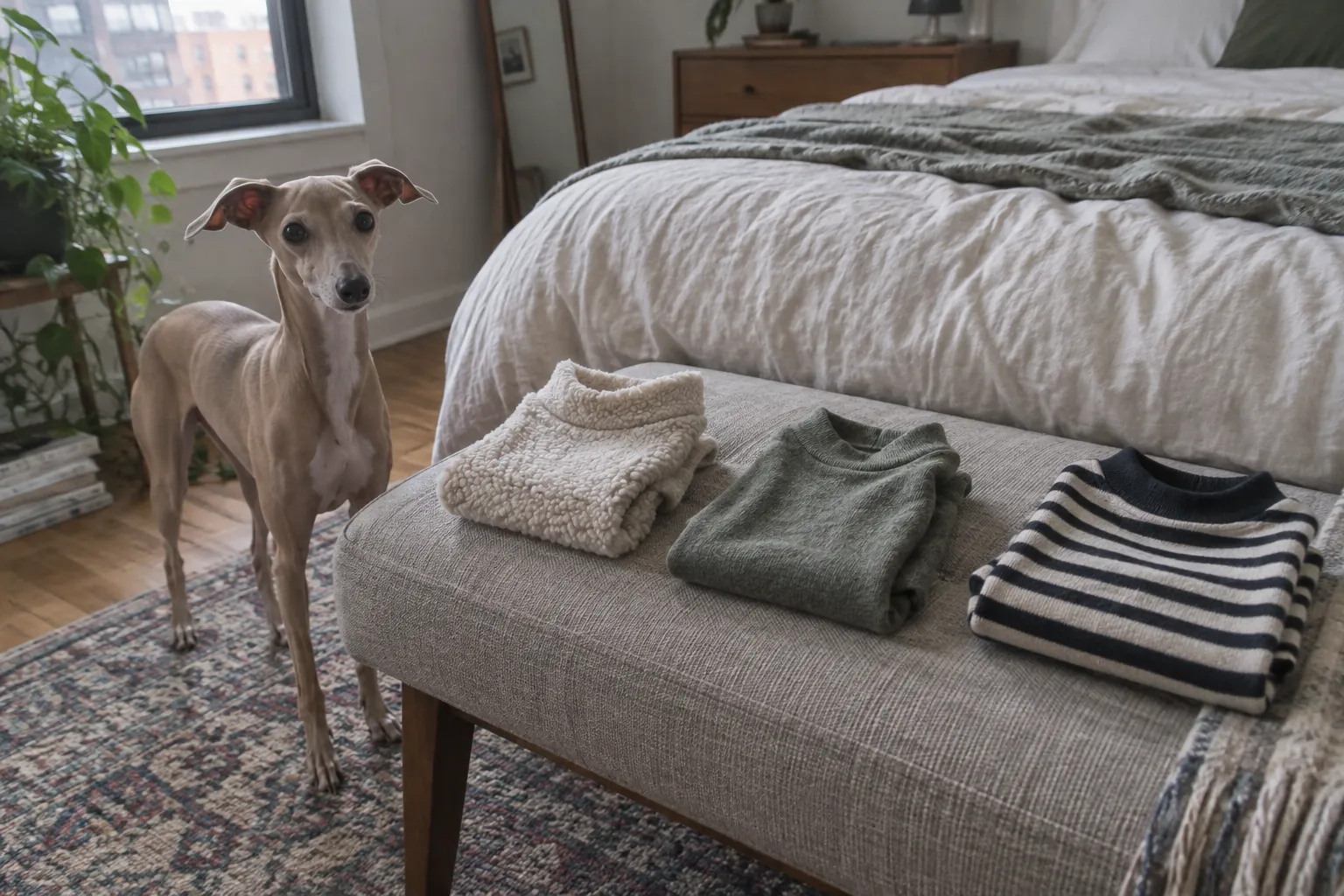
You do not need seven sweaters. To start, this is enough:
- A warm layer: a sweater, hoodie or sweatshirt for dry cool weather.
- A waterproof outer: a raincoat or poncho for rain and wind, over the warm layer.
- For frost: a winter suit and/or a snood for neck and ears.
- A dry spare: a second garment if the first does not dry in time after washing (our article on clothing care).
If there are few cold outings, one or two items are enough. Add to the wardrobe when it is clear what is missing.
Clothing at home
In a warm flat clothing is usually not needed. If the house is cold or the dog is chilly after a bath or rain, a soft indoor garment will do. Make sure the dog is not too hot: frequent heavy panting, looking for a cool place. Do not leave a new garment on the dog unsupervised until you are sure it is comfortable. More in our article on where it sleeps.
Colour
Choose colour to taste: in daylight it shows more accurately than under a lamp. A contrasting colour makes the dog more visible in a park and at dusk, but visibility does not replace attention to the road and lead. More on coat colour in our article on colours.
Fabrics and care
Fabric compositions in our catalogue are still being confirmed: see the product card. How to read a label and care for a garment is explained in our articles on fabrics and on clothing care. Take wet clothing off and dry it fully, especially the collar and cuffs.
Frequently asked questions
- Does an Italian Greyhound need clothing? In cold, damp and wind usually yes, in a warm flat no.
- How do I choose a size? By three measurements: back, chest, neck.
- How many garments do I need? To start two or three: a warm layer, a waterproof outer and, if it is cold, a suit or snood.
- Can I leave clothing on the dog indoors? Better to take it off: the dog may overheat.
- How do I get it used to clothing? Gradually, at home, with a treat.
What to remember
- Clothing is protection from cold and damp for an Italian Greyhound, not decoration.
- Choose size by three measurements and check the fit by how the dog moves.
- Two or three garments are enough to start.
- Take wet clothing off and dry it fully.
Sources
References for checking facts and reading further.
Useful? Save it for your next walk.